For some reason you have to double click on the photo in order to get the proper paragraph spacing.
In 1971 Robert hiked the entire Appalachian Trail from Georgia to Maine. By completing this 2000+-mile journey, he became just the 36th person to have walked the entire trail continuously in one year. Along the way, Robert carried an old Argus C-3 camera that he borrowed from his grandfather. It had no light meter so Robert wrote down all of his exposures in a notebook so that he could learn the best camera settings for different light conditions. Upon completion of the Trail, Rodale Press contacted Robert to contribute to a book called “Hiking the Appalachian Trail”. One of his photos appeared on the cover of the second volume along with thirteen other photos on the inside.
While Robert was completing his graduate work in biology, he entered a photo contest run by Nikon and won a fourth place. Later, while teaching at Idaho State University, Robert took photography courses in the Art and Journalism departments. At this time, he also began teaching nature photography classes.
Robert is an internationally known nature photographer with thousands of published images. He holds a master's degree in Biology and taught Outdoor Education and Wilderness Studies as a full time faculty member at Idaho State University for six years. Since moving to Durango in 1981, Robert has been a full time freelance photographer. His work has appeared in/on many books, magazines, gift items and in over 20 different calendars in one year. His photos have been used in national ad campaigns by such diverse entities as Adobe, Amtrak, The National Audubon Society, The National Geographic Society, The Nature Conservancy and Phillips Petroleum.
Several of Robert’s photos are in a new video presentation produced by the WildEarth Guardians and narrated by Alan Arkin to facilitate efforts to protect and restore wolves. The 2011 International Wolf Center Calendar was exclusively Robert's photos.
He has won numerous photo awards including Grand Prize winner in the National Wildlife Cover Photo Contest out of over 10,000 entries. He is also the First Place Winner in the Wildlife Category In Outdoor Photographer's Magical Adventures Photo Contest.
Robert has run customized individual and private group photo tours to select locations around the world for over 20 years. He is semi-retired from leading these tours so please contact Robert directly if you are interested in traveling to Kenya or other locations. Robert is currently retired from teaching advanced photography programs for The Mountains and Plains Institute for Lifelong Learning and Service.
Since 1981 Robert has lived in Durango, Colorado where for some unknown reason he is included in a list of Famous Faces of Durango at www.durango.org/durango-area/people
He has been married to the amazing Marilyn S. Leftwich, PhD since 1987.
Contact information
Robert Winslow
Robert Winslow Photo, Inc.
Mail: PO Box 334
Durango, CO 81302-0334
Courier: 235 Oak Road, Rafter J
Durango, CO 81303-7655
Phone: 970-259-4143
Email: rwinslow@mydurango.net
Robert's Facebook address: http://www.facebook.com/home.php?#/profile.php?ref=name&id=100000550352839
Bob and Marilyn's personal website: www.marilynandbob.smugmug.com
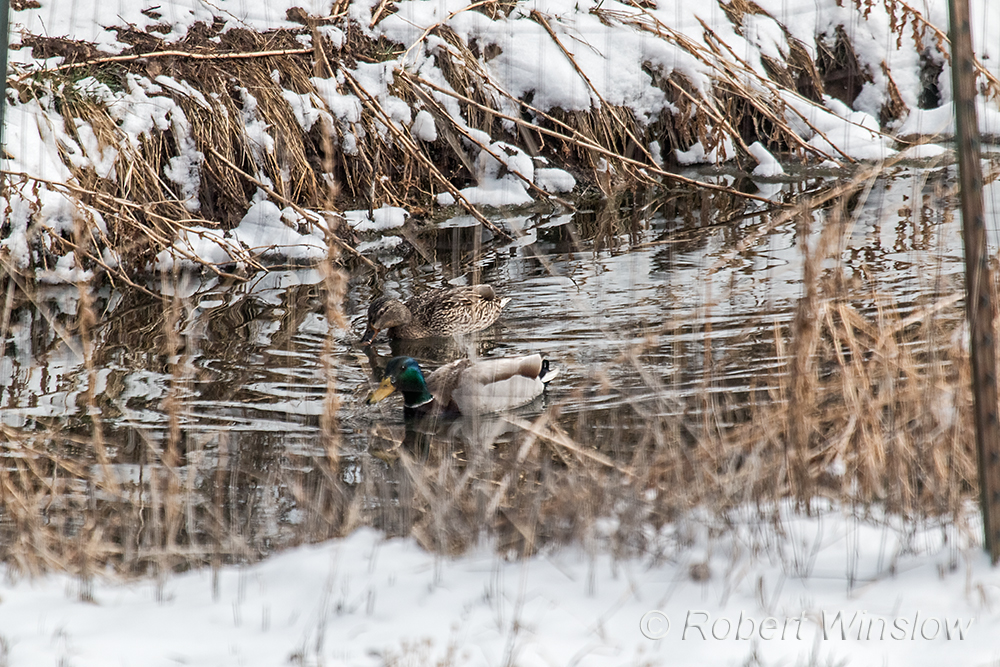
Every year a male and female Mallard pair show up to swim and feed in my very small wastewater lagoon (one photo shows how small it really is). The water goes from the house into a septic system and then flows into this small open-air lagoon.
For many years these two Mallards have shown up every Spring. They swim around and obvious feed. They don’t stay overnight, but fly off to someplace to spend the night and arrive again early the next morning…..They do not make a nest or raise young there. It is certainly curious why they have chosen this place to come to every year…..They are not habituated at all and fly off if I walk around on that side of the house.. Occasionally, last year, the male would come and feed on the birdseed under Grandmother Tree, but it would waddle off or fly away if I appeared too close at a window.
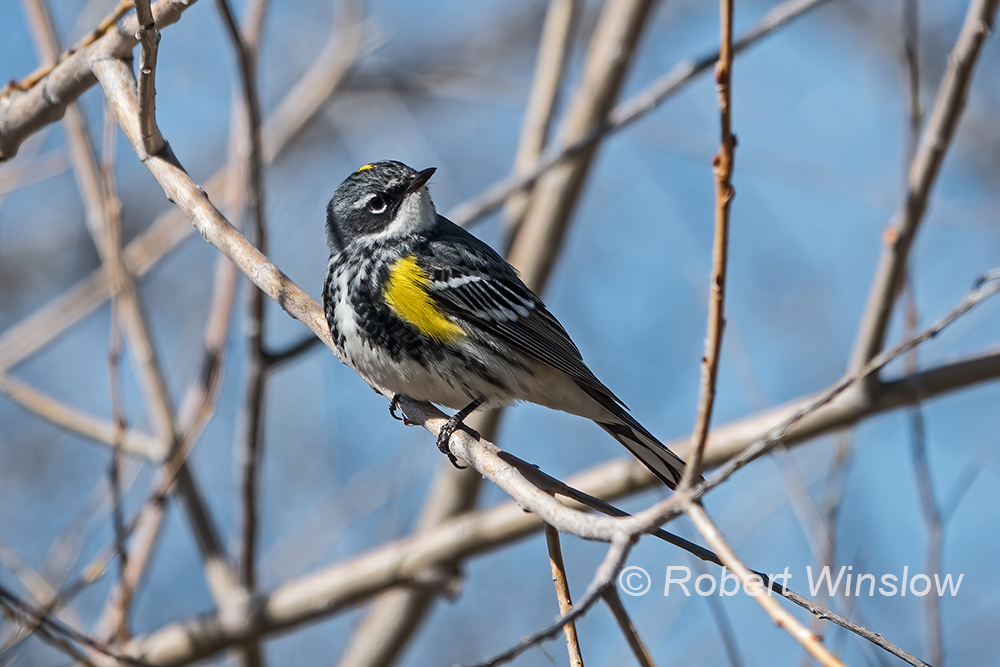
There are two subspecies of Yellow-rumps – which are often referred to as “butter butts’. The Mrytle has a white throat…much less common in my area, but definitely not a rarity.
The Audubon’s has a yellow throat…these are the most common in my area. Today, we saw over 60.











 Adventures, Animals and Images