A Wonderful Conservation Story

The Panda TwinsW8

This blog post is not about me or any of my photographs. It is about a wonderful thing that my good friend Dr. Katherine Feng did to help preserve the White-headed Langur Monkeys in China while at the same time coming to the aid of a local farmer and his son.

For those of you who do not know Katherine, at the bottom of this blog, I have included a couple of bios written about Katherine as they appear on the Harper Collins and Strabo Tours websites.

The shlepper

The White-headed Langurs are a Critically Endangered Species. “A critically endangered (CR) species is one which has been categorized by the International Union for Conservation of Nature  as facing a very high risk of extinction in the wild.” – Wikipedia

There are fewer than 1,000 white-headed langurs in the world and all of them are located in the White-headed Langur Nature Reserve near Chongzuo, Guangxi Zhuang Autonomous Region.  This makes them more endangered than the giant pandas. – Katherine Feng
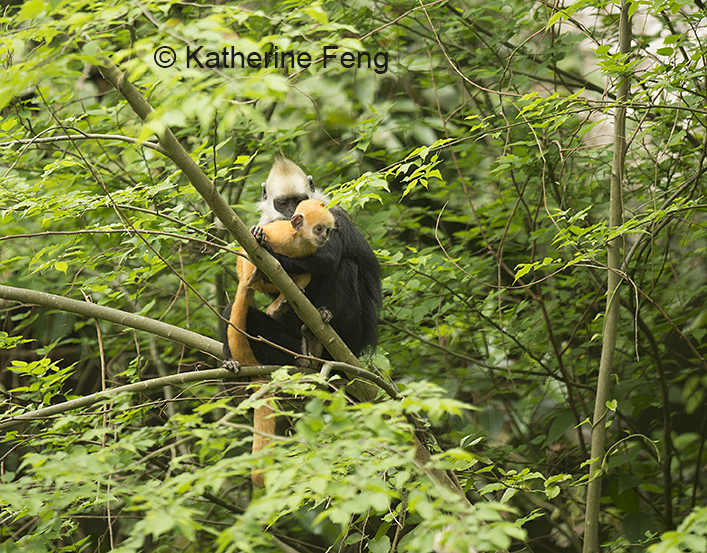
Adult and infant white-headed langur

Hopefully this story will inspire someone to help conservation in some way.

What follows is a letter that I recently received from Katherine.

Hi Bob,

The Chongzuo White-headed Langur Nature Reserve is unique in China in that although the bureau has authority over the karst rock formations, the land belongs to the farmers. The Bureau has no jurisdiction over the land up to the base of the mountains.  Also, their budget is very small.

So, as I was photographing the langurs over several days, I saw that a farmer and his family were clearing their land in preparation of planting a species of eucalyptus trees which is used commercially.  The trees are densely planted and grow quickly so the farmers can cut down the trees in about 6 years.  The problem was that this alcove is vital to the langurs in this area.  They depend upon the vegetation for food, their sleeping area is along the side of the mountain (cliff on right side) and they must have clear view of the surrounding mountains for the sake of avoiding competing males.  A stand of eucalyptus trees would not have allowed the sun to reach the vegetation needed for the langur’s survival and the density of the stand would have obliterated any view of the surrounding mountains.

What to do? I sent the above photos to the nature reserve which shows not only the nature reserve boundary but a lot of the land that was already cleared.  For three days I did not get a response. Near the end of my stay I realized the situation was critical.   Neither the driver or the local nature reserve staff would help me communicate with the farmer and so in my horrible Chinese I asked the son (older generation only understand the local Zhuang dialect) how much it would cost to have him not plant the eucalyptus trees but let someone rent the land.  He said 1,000 yuan per year which is about $160/year. Time was of the essence as I was leaving on Friday and it was Wednesday.  So I called the Nature Reserve and spoke to the one person who understands some English.  I offered to pay the $160/year for a period of 10 years!

The nature reserve director (who started just 3 months ago) agreed to my proposal.  He came out to the field on Thursday and we pretty much spent the whole day surveying the area and negotiating with the farmer.  The father, who was the owner of the land, wanted to continue planting the trees or wanted a lot more money.  I could not offer more that the amount the son quoted me.  After a lot of negotiating, the farmer agreed to rent to the nature reserve for 1,000 yuan/year  a piece of land that was actually a bit larger (but just a critical to the langurs) than I had initially planned.

Turns out that the Nature Reserve Director is a local Zhuang person who speaks the local dialect and understands the farmer’s situation.  He pointed out that the market value is variable and if he accepted our offer, he could be assured of a decent reliable income.  To our favor, the father is 65yrs old and he wanted his son to continue farming the land.  But the son wanted to go into the city to find work, not continue the hard work of farming with little income.  The son pointed out that if the father accepted our offer, he could go to the city and his father would have a reasonable income during his old age when he could no longer work the land.

So, in the end, the father accepted our offer.  Actually the nature reserve wanted the contract to be for 30 years instead of the initial 10 which I offered to support.  He hopes that at the end of 10 years the nature reserve will find a means to continue renting the land.  Everyone concerned reached a verbal agreement which was written on a piece of paper with everyone’s signature.  An attorney will draw up a final contract and when it is signed by all concerned parties, a scanned copy will be sent to me.  To seal the deal, I had to hand over the first 5 years’ worth of rent (5,000 yuan or $800).  Not really what I had budgeted for this year but necessary for everyone to feel comfortable about the deal.

Instead of the eucalyptus trees, the nature reserve will plant trees and vegetation that the langurs will eat.  That will be especially important during the winter months when a lot of trees lose their leaves.  It is a win-win situation for all involved:  the langurs, the environment, the nature reserve, the old farmer, his son and me.  I am happy to have the opportunity to do some good and I am now in solid with the nature reserve.  Also, as I hope to do a story about the langurs, it will be good to add how the nature reserve works with the local people to help protect the langurs.

I just thought you would be interested in this story.

From a more recent email from Katherine

Saved Land_2I am attaching two images (saved land) taken with my smart phone.  They show the alcove surrounded by three mountains on which one group lives.  The family overnights on the cliff to the very left.  Challenging males will approach the family from the mountain on the left or in the center.  The images also show the area the farmer has cleared and dug holes for the eucalyptus trees which he had intended to plant.  In addition to all the vegetation the farmers cleared, they also cut down trees which were very close to the rocks/mountains. The vegetation and trees are important food for the langurs, especially in the winter when food is scarce.  On behalf of the farmers; their work is extremely had.  The work was done by the 65 year old father, his 62 year old wife and his son (who wants to move to the city). 
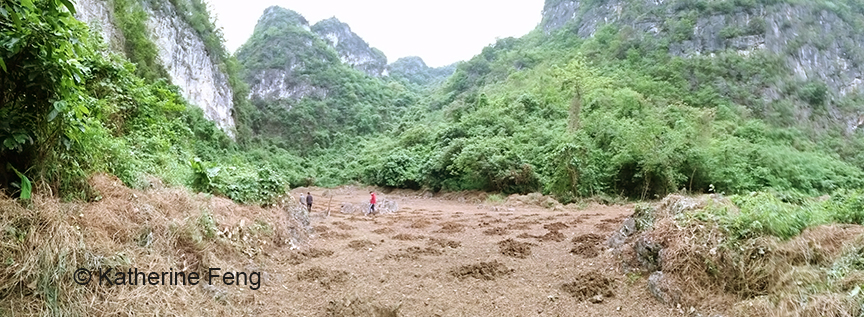
Saved land

From a subsequent email a few days later after I told her that I would like to post her story on this blog:

A friend read the written agreement from which an attorney will draw up the legal contract.  If she understood it correctly, it turns out the nature reserve will rent the piece of property I agreed to save at 1,000 yuan/year plus another larger section for an additional 3,100 yuan/year. And the contract will be for 30 years.  The reason they wanted my 5,000 yuan up front was because the nature reserve did not have the funds to pay the farmer the entire 4,100 yuan and wanted to use my money to give the farmer at the signing of the contract.  He hopes to use the fact that the granddaughter of Feng Yuxiang who lives in the USA was willing to spend 1,000 yuan/year to save the langur’s habitat and the nature reserve should surely do what it can to protect the langurs.  The nature reserve took a copy of my passport and donation receipt as proof I was there and used my own money for langur protection.

 Whatever, at least I know that I instigated the whole transaction and in the process, not only the critical piece of habitat will be saved, but also some adjoining land that is also important but that I could not afford to pay the rental fee.  And it is still a win-win situation for everyone that would not have happened if I had not been there.  It was something that was meant to be!

 You can use the story on your blog.  If It can inspire someone to help conservation in any way, it will be great.

The agreementKatherine’s caption for the above image.

  • One photo shows the farmers (father on the left, son on the right), the nature reserve staff drawing up and agreement and the nature reserve director in the background.  A formal agreement drafted by an attorney will be the final document.  When it is signed by all involved parties, the farmer will receive my $800 (5,000 yuan)

Coming up with $800 was a bit of a hardship for Katherine. Marilyn and I have made a donation to help pay some of this amount. If anyone else wants to also help they can send a check to me or directly to Katherine at PO Box 4597, Durango, CO 81302
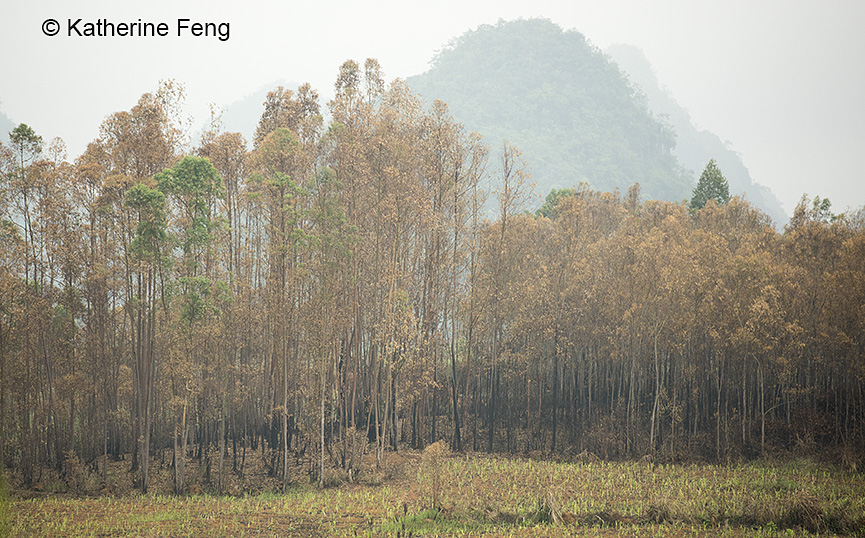
Burned eucalyptus grove

I have included two images of eucalyptus groves.  They are not great due to the weather and timing but they show what I wanted.  One is that the trees are densely planted and that they are very tall.  You can imagine how the trees would have impacted the langurs had the farmers planted them.  The trees would have blocked the views of the surrounding mountains making the langurs vulnerable to challenging males.  As with other species, if a new male takes over the group,  all the young offspring from the defeated male will be killed.  One image is of a burned eucalyptus grove.  It is significant because the farmers burn the sugar cane fields before replanting and sometimes the fire can get away from them, as did the fire that caused this eucalyptus to burn.  Again, one can imagine what would happen to the langur habitat if an eucalyptus grove caught fire in the alcove.  The green grove has a stone wall around it.  – from a recent email from Katherine
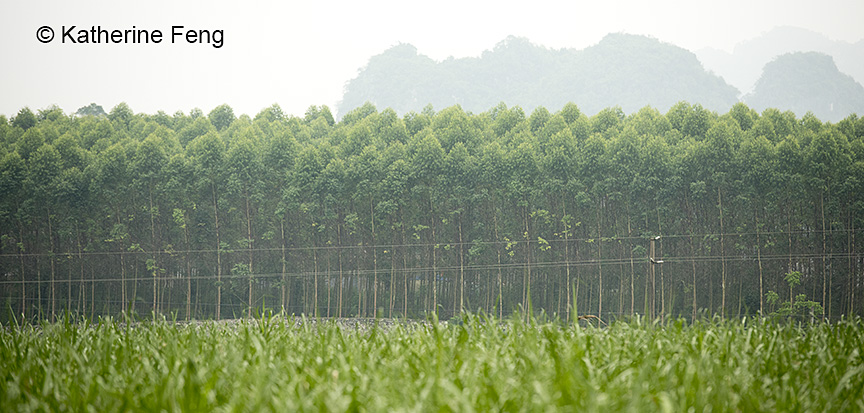
Eucalyptus grove

Harper Collins bio: Dr. Katherine Feng was a veterinarian before a photo safari to Kenya inspired her to pursue a second career as a photographer and tour escort. When she traveled to China in 1982 for a memorial ceremony in honor of her grandfather, General Feng Yuxiang, she felt an immediate connection with the country. Her passion for wildlife brought her to the Wolong Nature Reserve, where she formed a long-lasting bond with the pandas and researchers. She now escorts guests to the Reserve several times each year. Dr. Feng lives in Durango, Colorado.

Strabo tours Bio:TOUR ESCORT In 1982 Katherine Feng was invited by the government of the People’s Republic of China to participate in a memorial ceremony in honor of her grandfather, General Feng Yuxiang (General Feng is a national hero famous for ousting the last emperor from Beijing’s Forbidden City and setting up the Imperial Palace as a museum for the people of China, his battles against the Japanese during World War II, and the great love he had for his country). Katherine immediately fell in love with China, its people, landscape, and ancient heritage. She has since traveled to China numerous times to discover her roots and learn of her grandfather’s legacy. Katherine’s family ties have granted her unique access to locales and events that remain hidden from the majority of travelers to China – hidden secrets Katherine is excited to share.

Katherine has been leading international tours since 1993. She has led both photographic and special interest tours to China, Tibet, and East Africa. She is known for her ability to connect with the local people and to give her groups a more intimate experience in the countries they visit. Her aim is to show people the beauty of the world and to inspire others to learn about, understand and respect the different cultures in it.

As a photographer, Katherine’s photographs have won numerous awards including first place in the National Geographic Traveler Photo Contest and Best of Show in the International Wildlife Film Festival. Her photos have been published internationally in magazines, books (including National Geographic Magazine, International Wildlife, the cover of Frommer’s 1999 China Travel Guidebook), and numerous calendars. Dr. Feng’s documentary photography of the Giant Pandas at Wolong Nature Reserve has earned her international recognition and acclaim.

An Unforgettable Afternoon with the Pronghorn

It is always quite thrilling to find yourself looking at a world you know well but have never seen from such an angle before – Bill Bryson

Sorry.  The editing needs some formatting work.  WordPress does a horrible job helping arrange text and photos.

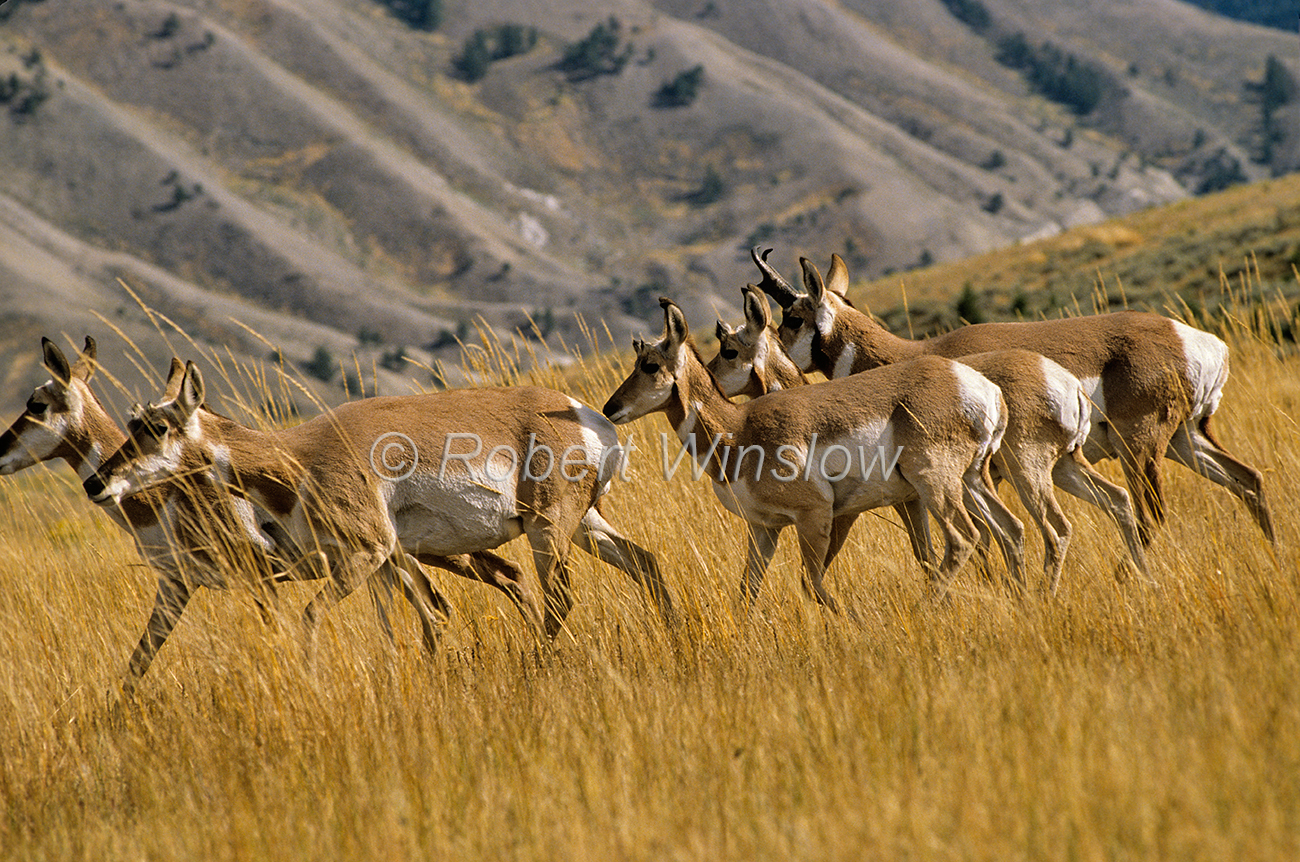
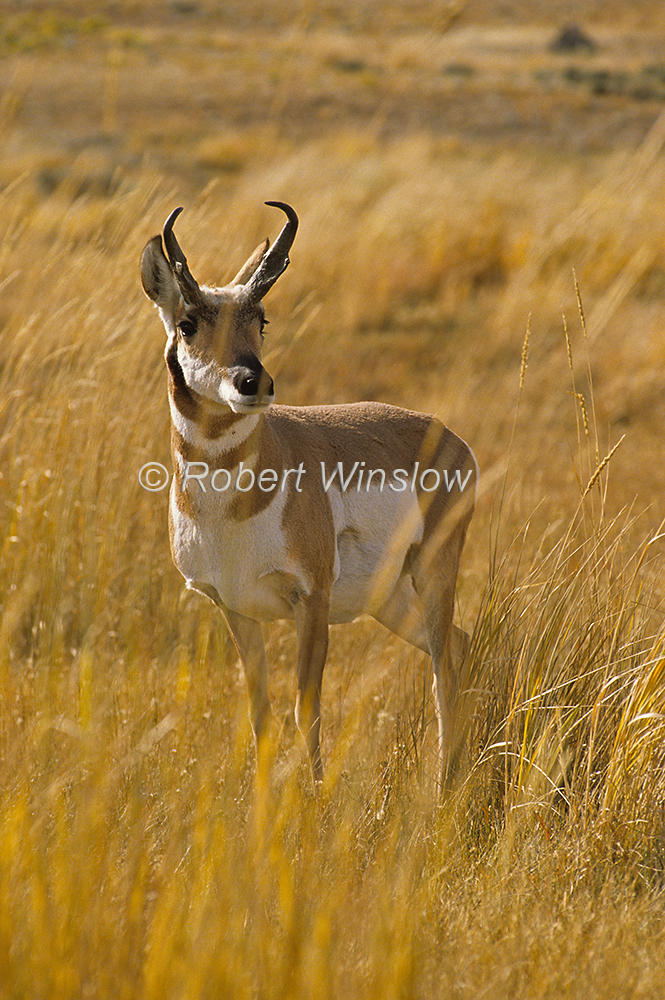
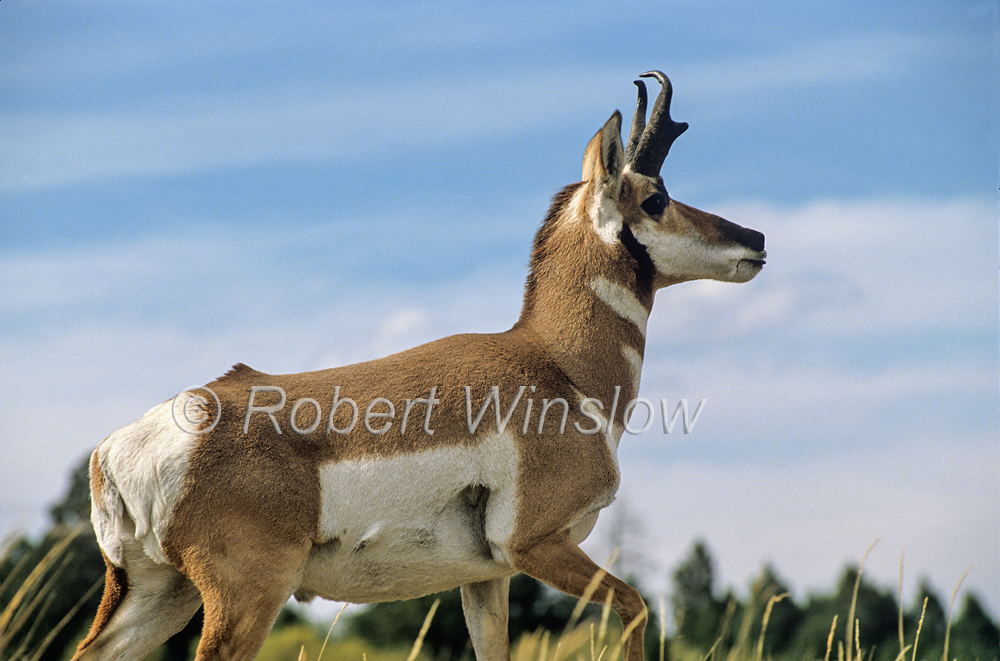
This unforgettable adventure happened many years ago. Back in the film days. It was late September and I was camped up near Mammoth Hot Springs at the Northwestern corner of Yellowstone National Park. One day I was out photographing and happened to meet another photographer.  He told be about a herd of Pronghorns that he had seen. The herd was grazing a couple of small hills to the west and required maybe twenty minutes of hiking to reach their location. The Pronghorns were not visible from any road. I started out hiking with a couple of rolls of film in my pocket and one camera with an 80-200mm zoom attached. My goal was to get a head shot of a male pronghorn.

Since I had all afternoon and had no other place to go, I took my time. When I thought I was getting close to the herd I sat down and didn’t move for at least ten minutes. Slowly, I moved forward. After cresting a rise I saw the herd in the distance – maybe seventy-five yards away. I moved very slowly toward them on my hands and knees stopping every few feet to sit down, chew on some grass and not look at the animals.

A-040-F-16W13WM

When I got closer a very interesting thing happened. I was sitting down chewing on some grass when the big male in the herd became aware of my existence. I don’t know if he saw or smelled me. Either way, what he did next was fascinating.

Pronghorn W13WM He took a small group of females and herded them entirely around me in one direction and then in the other direction a full 360 degrees each way. He always kept the females between me and himself.

I didn’t move, continued to chew some grass and did manage to grab a few photos as I was being circled.

A-040-A-17W13WMOnce that was over and the Pronghorn did not see me as a threat they relaxed and went back to grazing and ignored me. I continued to get closer until I was sitting right in the middle of the herd!

A-040-A-18W1WMA-040-A-20W13WM

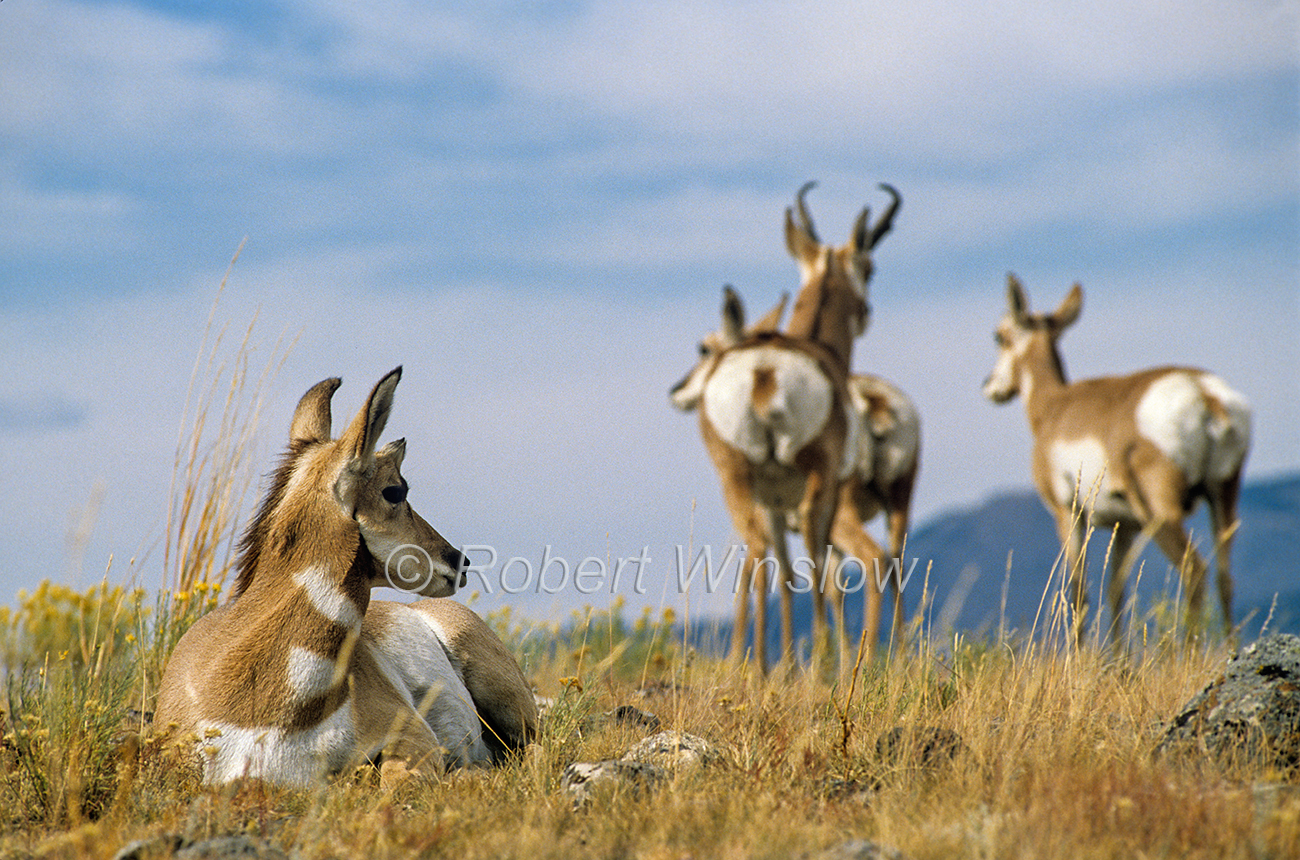
I probably sat there for a little less than an hour. There was a slightly smaller male and the two males fought. They would put their heads down, lock horns and then push each other all around the ridgeline which was maybe thirty yards away. The males never got too close to me, but the females where easily within ten feet of me.

A-040-F-19W13WMA-040-F-18W13WM

A-040-C-04W13WMA-040-F17W1WM

I was running out of film in my second and last roll and I still did not have a good head shot of the big male Pronghorn.

A-040-G-01W13WM

Eventually, the big male came closer. What he did next was also amazing – and a little scary. He got one female that was nearby and nudged her to stand up. He then drove the female within six inches of my right shoulder.

A-040-C-14NW13WM


The male followed – getting closer. I was still sitting down.

I grabbed my camera and fired off two final frames and when the male was within about five feet of me I quickly stood up, waved my arms and yelled something. The Pronghorn bolted and stopped about 50 yards away. I ambled back to my vehicle. The time from leaving my vehicle to returning to it was about 2.5 hours. It was definitely one of the most extraordinary events I’ve ever experienced in the natural world.

175W113WM

How the Chickadee got its Black Cap and other Related True Stories

I’m taking a birding class. We meet once a month for eight months. Each evening class is two hours in length. There are also field trips. The instructor, Kristi Dranginis, has developed a wonderful curriculum. Each month she emails us a different workbook chapter. Each chapter has a month’s worth of different activities and assignments as well as interesting stories from her own personal experiences as well as different cultural myths and fairy tales about birds.
In order for us to develop a more intimate relationship with the birds in our area, one of the first activities for each class member was to find our Bird Mentor. Throughout the following months, we are then to continue to get to know this Bird Mentor as we progress from chapter to chapter.

To find our Bird Mentor, Kristi asked each student to select a name from a bag. When it was my turn, I swirled my hand around in the bag and pulled out a piece of paper with Black-capped Chickadee written on it. Although not exactly the same, the experience was not unlike having the Sorting Hat placed on one’s head at Hogwarts!

The first activity in this month’s chapter was to “Bring the relationship, knowledge and connection you have with your Bird Mentor to a new and rich place….Your mission today is to write the fairy tale of your Bird Mentor.”

It’s questionable if what follows is really a fairy tale. It might be more like a myth, but I am really not sure of the actual difference between the two.

How the Chickadee got its Black Cap and other Related True Stories

© Robert Winslow

 In every walk with nature one receives far more than he seeks. – John Muir

I

Once upon a magical time, years and years and years ago when I was in grad school and there were wolves in the woods behind my little house, pale gray, black-throated, white-headed, white-cheeked, buffy flanked little birds flitted over the heart-shaped hills. Before the motor car, before the wheel, before the duchess-faced deer as I strode those ragged ravines and stormy summits with a backpack it snowed and it snowed.

Overnight, the snow grew out of the branches and boughs and boles of the trees and the roof of a small secluded log cabin nestled deep in the silent forest. I had snowshoed into it while my fellow students were off for the week in warmer climes during our spring break from the university. The cabin, owned and operated by the local mountain club, was complete with a wood stove, firewood, a bunk bed, a few dishes, utensils, a tool box, bird seed and a bird feeder. A nearby stream provided fresh water.

cabin 1W15

Upon arriving I lit a fire in the stove to warm the cozy cabin and then filled the bird feeder – which was nothing more than a platform hanging from a branch. Shortly, the pale gray, buffy-flanked little birds with white heads and black throats started arriving and feeding on the sunflower seeds on the wooden boards. They chattered chick adee dee dee. “We are very hungry. Thank you for this food,” They chorused. “We will eat some of these seeds and then hide the rest so that we will have food for later. We can remember thousands of different hiding places” Upon hearing the Chickadee chatterings, within minutes other birds came – including juncos and nuthatches.

Unseen and lurking high up in the canopy were several great gray squirrels who had stashed away enough food for the winter, but were eager for any new treats. Down the tree they bounded, jumped onto the swinging platform filled with sunflower seeds and chased away all of the hungry birds.

The squirrels sat there eating and eating and eating while the Chickadees became more and more agitated calling out chickadee dee dee dee dee dee. The more upset they became, the more dee notes they added to their calls. We watched and waited and waited for the greedy gray squirrels to leave. They did not do so until all of the sunflower seeds had been devoured. The Chickadees were sad and hungry as there weren’t any insects or spiders to eat on this cold winter day, but the squirrels would not let them have even one little bit of food.

II

 Observing this drama unfolding outside the cabin’s frosty window and feeling sorry for the hungry Chickadees, I hunted around for a solution. What I found was an old blackened sooty stove pipe tucked away in a corner of the woodshed that was destined to be hauled out in the summer time. Using tin snips found in the tool box I fashioned the stovepipe into a cone and secured it so that it hung just high enough above the feeder so that the little chickadees, nuthatches and juncos could get in, but the squirrels could not. The metal stove pipe hung like a slightly flattened dunce cap over the platform. I once more filled the feeder and went inside to watch.

Down jumped the squirrels almost immediately. But when they climbed down the rope that the bird feeder was hanging from, they encountered the cone shaped stove pipe covering the feeder and promptly slid to the ground. Frustrated the squirrels tried again and again but each time they slid to the ground. While this was going on the Chickadees flew down into the feeder’s small opening to where they were able to eat the sunflower seeds. They were so happy that once inside the cone covered feeder, they kept on hopping around and bumping their heads on the inside walls of the sooty stove pipe. As they did so the tops of their heads down past their eyes turned from white to a very dark black-cap. They also shook some of the soot down on the juncos and nuthatches. The juncos got most of it.

III

 On my last day as I was hiking back out on hard packed snow, I paused for a moment beside a field. It was snowing a big heavy Springtime snow and I leaned on my ski poles not wanting to leave. How long I lingered there I have no idea. It could have been ten minutes. It could have been two hours. I stood there suspended in time and transformed into the landscape.

snowstorm 3W15

I know that it sounds crazy, but as I stood there my gaze softened and I became part of that field and the woods beyond. Every nerve and fiber in my body told me so. Standing there, surrounded by the soft light and silent falling snow, leaning on my ski poles, I experienced a kind of muted grace – a very profound spiritual sense of peace and belonging. Then softly and without warning, a Chickadee sporting her new black-cap dropped down and landed on my snowshoes that were lashed to the pack on my back. She started singing. It was a beautiful lyrical song: fee bee fee bee or Hey Sweetie, Hey Sweetie. When I became aware of what was happening, I laughed out loud.

Chickadee 0420W14

“Oh, you startled me”, I said.

“I have come to deliver you a message from my brothers and sisters” said the Chickadee.

“Because you have given us food when we were hungry and needed it the most, we will always wear our black caps as a reminder of your kindness.”

“You have honored me beyond words.” I said humbly. “For when I am in your presence, and your brothers and sisters, I feel an overwhelming sense of gratitude. You constantly remind me of my connection to the natural world and how the natural world is connected to all things. I love you. Your song is a reminder to me of the greater community of life and the harmony that we all share. My soul feels soothed and healed when I hear you sing. And when I walk in the woods and see you in flocks being active, acrobatic and curious, I smile and feel a special sense of peace and belonging.”

Chickadee 0431bW13I paused a moment and then continued, “To show you my gratitude for these gifts that I feel in your presence, I promise to feed you and your friends every winter and as a special symbol of our bond I may, from time to time, just for fun, even offer you some sunflower seeds from my hand.”

After one more song, the Chickadee maiden flew away, but the magic remained.

 IV

 And so it was that for many many years during each winter season I would put out seed and suet and the beloved little birds would come and eat and sing to each other and to everyone. Then one enchanted afternoon, late in the Autumn, it started to snow. It was time to feed my friends once again.

Before pouring some sunflower seeds into the feeders, I grabbed a handful, stood out under a large juniper named “Grandmother Tree” and offered up my open palm. The Chickadees flew into the tree in their characteristic bouncy undulating flight, hopped from branch to branch and then dropped down with a flutter of wings to snatch a seed from my open hand before flying off again. Occasionally, one would sit perched on my fingers and peck a seed open without flying away.

After several moments, the light grew softer and the snowflakes became very strange and different looking. They appeared to be small but skillfully torn-up pieces of paper. Then slowly one of the Chickadees that had been feeding from my hand flew up and circled around and around as if looking for something. Eventually, it grabbed one these strange looking snowflakes. She took it in her delicate short thin black bill and gently dropped it down into my hand.

It was a carefully and lovingly folded piece of paper.

I opened it very slowly …. and found my name written on it.

 ********************

Author’s Notes

 The first two paragraphs were inspired – plagiarized – from this beautiful poetic section of a Child’s Christmas in Wales by Dylan Thomas

 “Years and years ago, when I was a boy, when there were wolves in Wales, and birds the color of red-flannel petticoats whisked past the harp-shaped hills, when we sang and wallowed all night and day in caves that smelt like Sunday afternoons in damp front farmhouse parlors, and we chased, with the jawbones of deacons, the English and the bears, before the motor car, before the wheel, before the duchess-faced horse, when we rode the daft and happy hills bareback, it snowed and it snowed …”

“But that was not the same snow,” I say. “Our snow was not only shaken from white wash buckets down the sky, it came shawling out of the ground and swam and drifted out of the arms and hands and bodies of the trees; snow grew overnight on the roofs of the houses like a pure and grandfather moss, minutely -ivied the walls and settled on the postman, opening the gate, like a dumb, numb thunder-storm of white, torn Christmas cards.”

“muted grace”  These words appear in the first sentence of The Emerald Mile by Kevin Fedarko

“active, acrobatic, curious” quoted directly from http://www.allaboutbirds.org/guide/black-capped_chickadee/lifehistory

Words, sentences and facts also used from the All About Birds website:

“The chickadee’s black cap and bib; white cheeks; gray back, wings, and tail; and whitish underside with buffy sides are distinctive.”

“The Black-Capped Chickadee hides seeds and other food items to eat later. Each item is placed in a different spot and the chickadee can remember thousands of hiding places.”

“The more dee notes in a chickadee-dee-dee call, the higher the threat level.”

“In most of North America, the song is a simple, pure 2 or 3-note whistled fee-bee or hey, sweetie.”

“Chickadees make their chickadee-dee-dee call using increasing numbers of dee notes when they are alarmed.”

And maybe this one from Whatbird.com

“Black bill is short and thin”

“soothed and healed” was taken from the following quote: “I go to nature to be soothed and healed, and to have my senses put in order.” – John Burroughs

Holiday Greetings

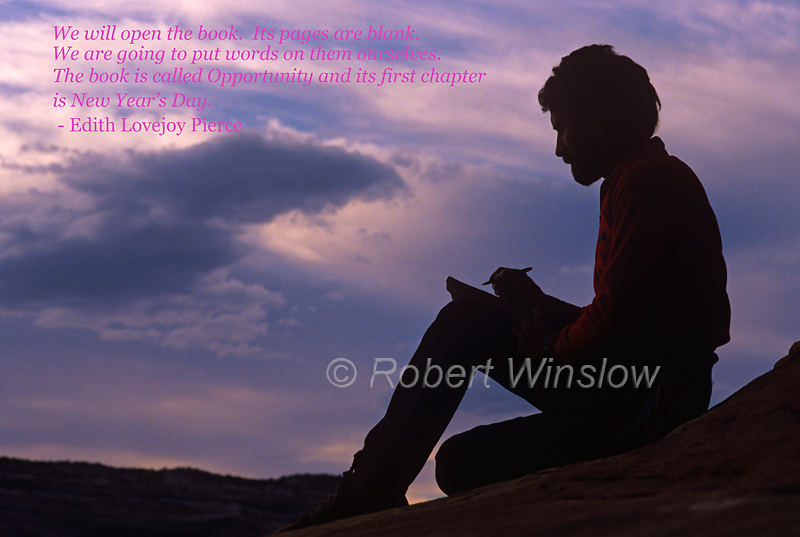
“Setting out on a new year is like opening a book. The same question pertains to each: “Where is this journey going to take me?” I’ve learned that no matter where it takes me I’m at my best when I go armed with gratitude to appreciate the very experience of being alive”. – Tom Ryan

Bald Eagle, Haliaeetus leucocephalus, Flying, Kenai Peninsula, Alaska

Silhouette of Man and Woman at Sunset, Badlands National Park, South Dakota

MR, Man writing in a journal in the outdoors

Reflection

   “To consult the rules of composition before making a picture is a little like consulting the laws of gravitation before going for a walk. Such rules and laws are deduced from the accomplished fact; they are the products of reflection.”  – Edward Weston

Took this photo of a Mule Deer Buck drinking water during last Wednesday’s Morning Bird Walk.

Mule Deer Buck Drinking Water 2739W1WM

A Quiet Day in the Woods. Many Years Ago.

My bird mentor is the Black-capped Chickadee

In every walk with nature one receives far more than he seeks. – John Muir

I’m taking a class in Birding this year.  One of the first things we did was find our Bird Mentor.  The instructor, Kristi, presented me with a bag that had several names in it of year-round birds in our area. I pulled out the one that read Black-capped Chickadee.  The experience was kind of like using the Sorting Hat at Hogwarts!

The first chapter for the class had several sections and lessons about being present in Nature as unobtrusively as possible. There was a section about Approach, Stalking the Wapiti, Sits Spot and the idea of blending into and becoming a part of the preexisting story of the natural world.  Chapter one reminded me of an experience that took place many years ago near Bear Mountain in extreme northwestern Connecticut. At the time I was a graduate student in Biology at the University of Hartford. One year, during Spring break – as others headed South to places like Florida – I reserved four nights at a remote rustic cabin nestled into the pines on the flanks of Bear Mountain, the highest point in the state of Connecticut. The Appalachian Trail – of which I am intimately familiar – runs over the top of Bear Mountain.

cabin 1W15

The best way for me to access the cabin was to drive into Massachusetts and then drive south until I hit a road called the Mt. Washington Road. It was not plowed so I had to park my car and from there backpack along the road for a ways until I picked up the trail that went to the cabin.

My notes from my fifth day are as follows: “On my last day as I was heading back towards my automobile on hard packed snow, I paused for a moment beside a field. It was snowing a big heavy Springtime snow and I leaned on my ski poles not wanting to leave. How long I lingered there I have no idea. It could have been ten minutes. It could have been two hours. I stood there suspended in time and transformed into the landscape.

snowstorm 3W15Chickadee 0431bW13I know that it sounds crazy, but I became a part of that field filling up with snow. Every nerve and fiber in my body told me so. And – after a while – a chickadee came and landed on my snowshoes that were lashed to the pack on my back and started singing. When I became aware of what was happening, I laughed out loud.

Chickadee 0420W14

The bird flew away, but the magic remained. It is good to go solo for a while. Mysteries and magic tend to reveal themselves at such times and the fields may perhaps yield a bountiful harvest.” (I took these photos a few years ago – at my bird feeder – to recreate the event)

San Juan Autumn Escape

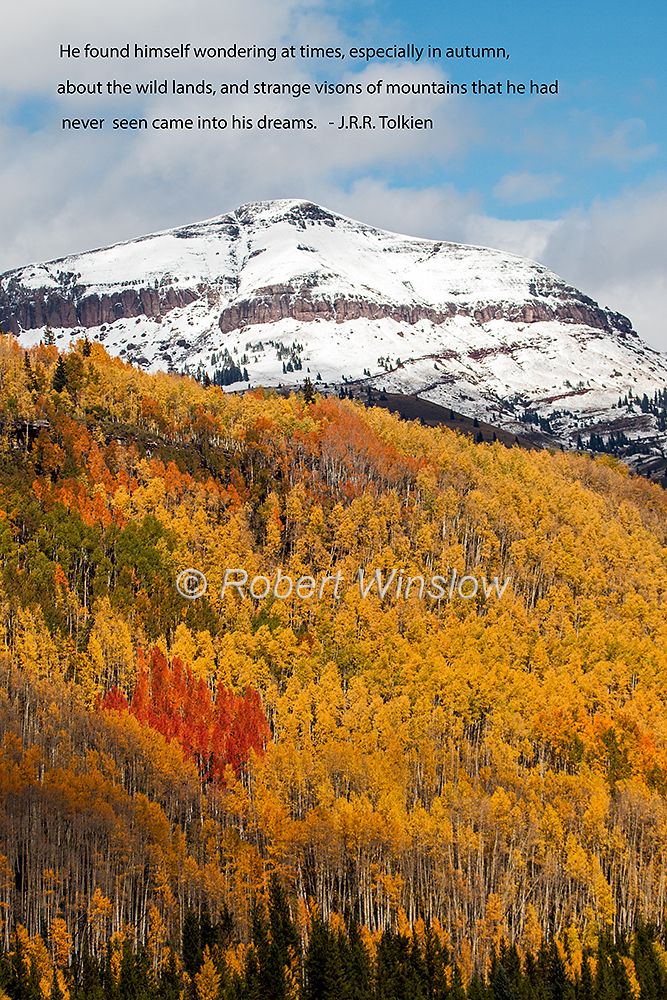
I cannot endure to waste anything so precious as autumnal sunshine by staying in the house. – Nathaniel Hawthorne

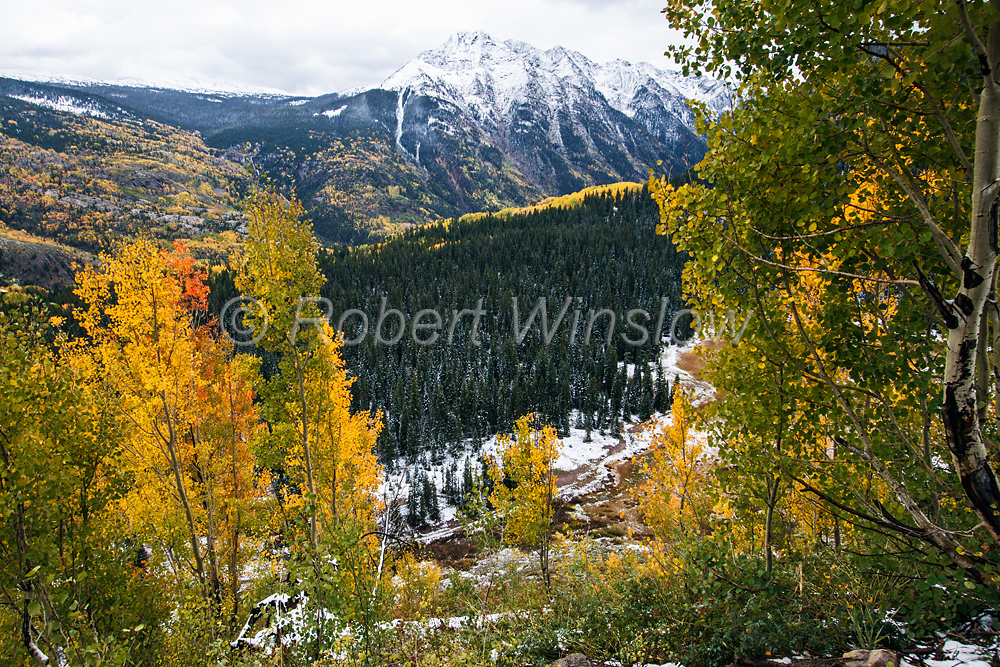
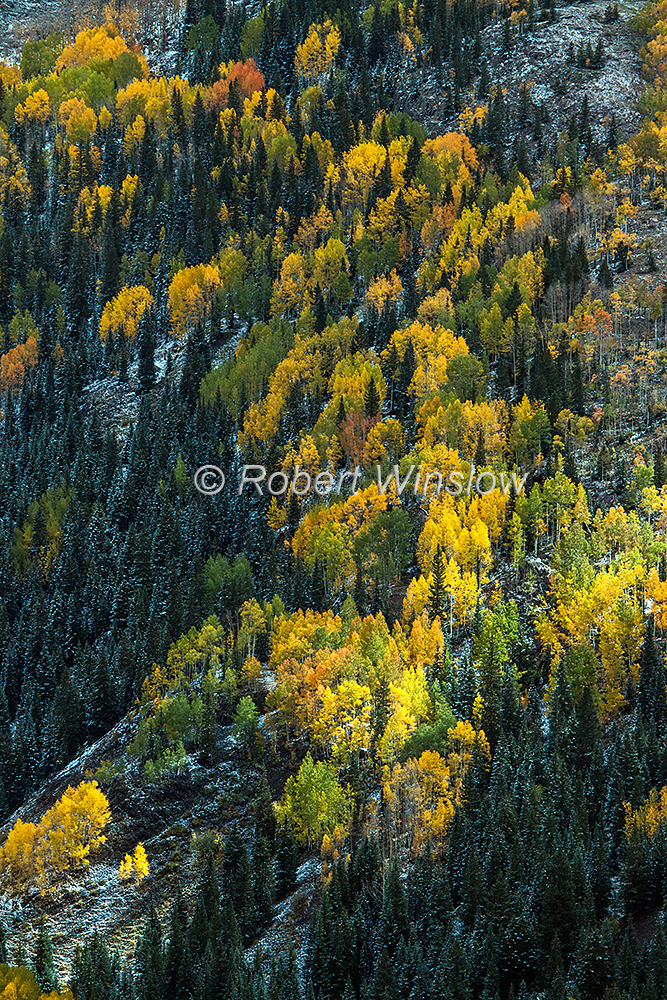
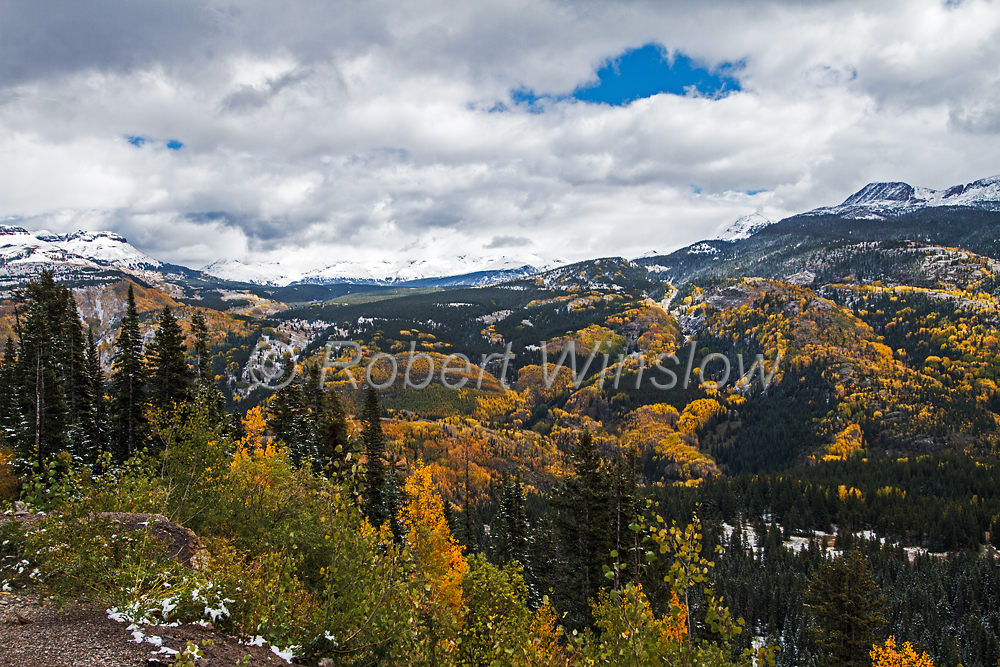
Despite the many pressing needs and responsibilities demanding our attention now that we are back home from Scotland, Marilyn, Duffy and I decided to take most of the day off on Tuesday and venture up into the mountains. The air was fresh and alive. The Fall colors were resplendent and there was some snow from a recent storm.  The sky was mostly cloudy with patches of sunshine trying to shine through from time to time.

So here’s a few photos from Durango’s back yard. Most of these images need to be viewed larger.  Double click on each one to make it so.  Onward.

San Juan Mountains Fall Colors 2361QW1WM

San Juan Mountains Fall Colors 2350W1WM2

The above photo is my favorite.

San Juan Mountains Fall Colors 6752W1WM

San Juan Mountains Fall Colors 2319W1WM

San Juan Mountains Fall Colors 6748W1WM

Marmot 2336W1WM

Duffy really had this guy chirping.

San Juan Mountains Fall Colors 2310bW1WM

San Juan Mountains Fall Colors 2312W1WM

San Juan Mountains Fall Colors 6746W1WM

San Juan Mountains Fall Colors 2327W1WM

San Juan Mountains Fall Colors 2315W1WM

Insect Eaters

        “All this is perfectly distinct to the observant eye, and yet could easily pass unnoticed by most.”                           Henry David Thoreau’s second to last sentence in his last journal entry (03 November 1861)


Warbling Vireo, Vireo gilvus, La Plata County, Colorado, USA, North America


Since the neighborhood disruption last week, I have been carrying my Canon 7D camera with a 100-400mm lens on both my morning and afternoon walks. These slow paced walks are definitely not cardio workouts and I’m not sure how much it is benefiting my health. It has, however, opened up a new world to me. This secret world has been going on around me for years and I really have been mostly ignorant of its existence.Warbling Vireo, Vireo gilvus, La Plata County, Colorado, USA, North America

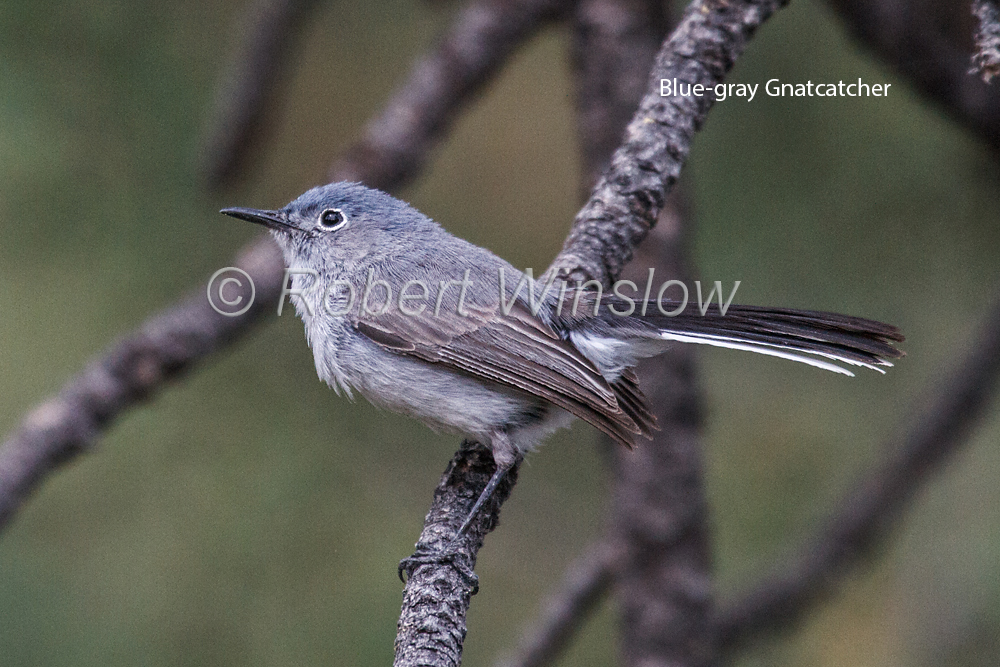
 While I’ve always been aware of the “seed eaters” (the ones that come to the bird feeders – chickadees, nuthatches, towhees, finches, jays, grosbeaks, goldfinches, etc.), I really haven’t been very aware of the “insect eaters” (warblers, vireos, flycatchers, gnatcatchers, etc.)Blue-gray Gnatcatcher 4683W1WML

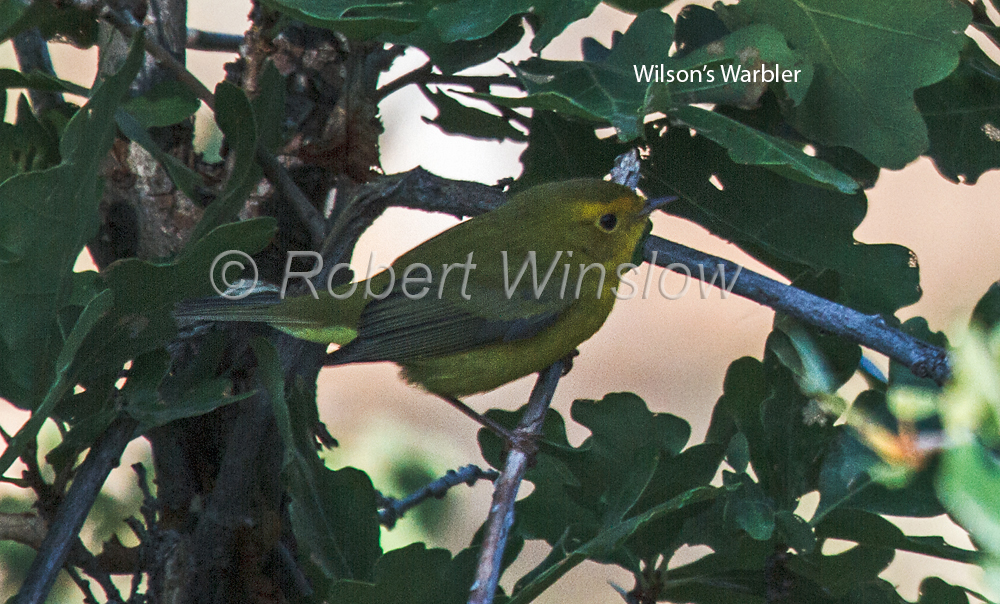
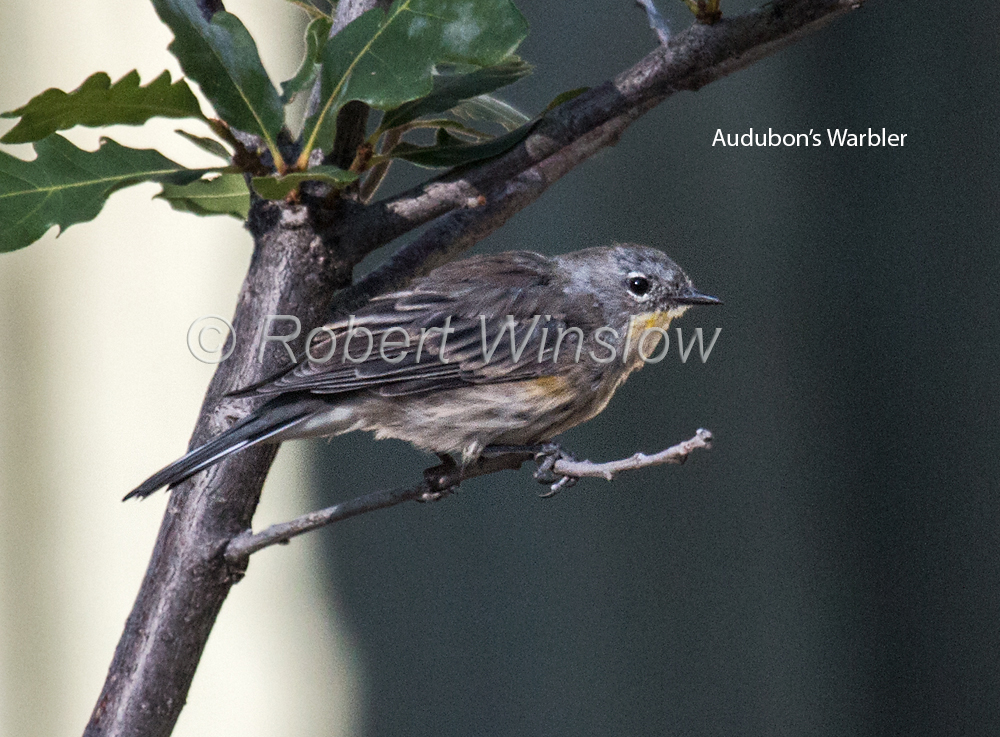
Over the summer – and even more so in the last few days – I’ve become keenly aware of the LGBs (little gray birds) that are flitting through the ponderosa, oaks and PJ. While they may appear to be LGBs, they are actually – upon close examination – really stunning in their colors, variety and numbers. The diversity is astonishing.  Cassin's Vireo, Vireo cassinii, La Plata County, Colorado, USA, North America

A number of these photos are not of publication quality. They did, however, make it possible for me to identify birds that I could never have identified in the field.

Warbler 5417W1WMLBlack-throated Gray Warbler 5379W1WML


The Loggerhead Shrike (which is really not an LBG) caused a bit of a discussion with some local birders because several field guides state that the black mask does not meet over the bill in the Northern. This appears to be the case in these photos. Also, the bird is very pale which would favor the Northern although it was probably an immature Loggerhead which (according to the Cornell Lab website) are gray and not brown. The fact that it was here in La Plata County at the end of August would indicate that it was a Loggerhead. Loggerhead Shrike 5336bW1WML

One other note about the Loggerhead Shrike photos – they were taken at ISO 1250!!! When I began looking at my photos at the end of the day, I noticed that there was a lot of noise. That’s when I noticed the high ISO in the metadata. I never photograph at that high an ISO when out photographing birds. The highest I might go might be 800.

Shrike 5337W1WML

Earlier that day, I was showing some of my bird photos that were still in my camera to the folks on the Wednesday morning bird walk. A couple of the people were holding my camera and scrolling through the various images. Someone must have also hit the ISO button while they were scrolling and changed the settings. Lesson learned. Always check your camera settings before a photo session – and especially after someone else has been holding your camera. Audubon's Warbler 0450W1WMT

Virgina's Warbler 5461W1WMT

And check out those little insect eaters.  It will open up a whole new world to you.


It was my fault that there was a disturbance in the neighborhood last Thursday.

It was my fault that there was a disturbance in the neighborhood last Thursday. It all started when I walked down to get the paper with Duffy, the dog. Maybe if I had my camera with me things might have gotten even more disruptive.

Lately, I’ve taken to carrying my binoculars with me when I go for my morning and afternoon walks. I do this so that I can better see – and hopefully identify – the birds that I observe along the way. A number of times recently I’ve taken my camera and 100-400mm lens with me. At 400mm and with the 1.6x magnification factor of the Canon digital camera, I can obtain the equivalent of a 640mm telephoto lens. Blowing up the resulting image even larger often results in some fairly good photos which makes the bird identification much easier. I am by no means an expert at identifying birds with binoculars. If it is a bird that is fairly common and I am familiar with it, I can usually identify the bird. If it is not common or I am not familiar with the bird, I often struggle to observe and recall all of the field marks that might be necessary for a positive identification.

So, in Thursday’s refreshing morning air, as the Duffster and I sauntered along on Wildcat Road just after turning off of Oak Road, I observed a flash of bright red color. I had my binoculars with me and viewed a bird that instantly reminded me of East Africa’s Hunter’s Sunbird http://www.robertwinslowphoto.com/Animals/Birds/Birds-of-East-Africa/i-mbRXJPs

Or a Scarlet-chested Sunbird

http://www.robertwinslowphoto.com/Animals/Birds/Birds-of-East-Africa/i-XNgn5wd

The bird had a bright red chest and black body and showed a flash of white when it flew. I only saw it for 5-10 seconds and then continued on. When I got back to the house and looked in Sibley’s Western Field Guide. The bird that came closest was a Painted Redstart, but it was not supposed to be seen in our area.

That afternoon I emailed Susan, the premier bird expert living in our area and told her what I saw and described the habitat and location. She got excited because it must have been a Painted Redstart and it is a rare bird for our area and Colorado in general.

Apparently, one had been seen in Mancos (about 30 miles West of here) three years ago in similar habitat. She asked if it would be okay to notify the statewide birder hot line and a few of the serious local birders (the types that have life lists that might include seasonal lists, county lists, state lists, country lists and world-wide lists).

I told her to hold off on the state notification and just tell a few of the locals. About a half-hour later, I headed for town to run an errand and encountered two birders walking along the road. When I returned home there were several cars parked along the road and more birders searching the area. Some of the neighbors went out and inquired what was going on. One thought that an elderly man must have been lost as it looked like he was wandering around aimlessly.

Late that afternoon Susan showed up. In the first half hour, she had identified a number of birds that I had never seen before on my walks. In the morning, Susan and her husband, Pete showed up. We all went out to look again. Later that morning, after meeting with a contractor, I went out and caught up with Susan. I showed her some similar habitat where I take my afternoon walks.

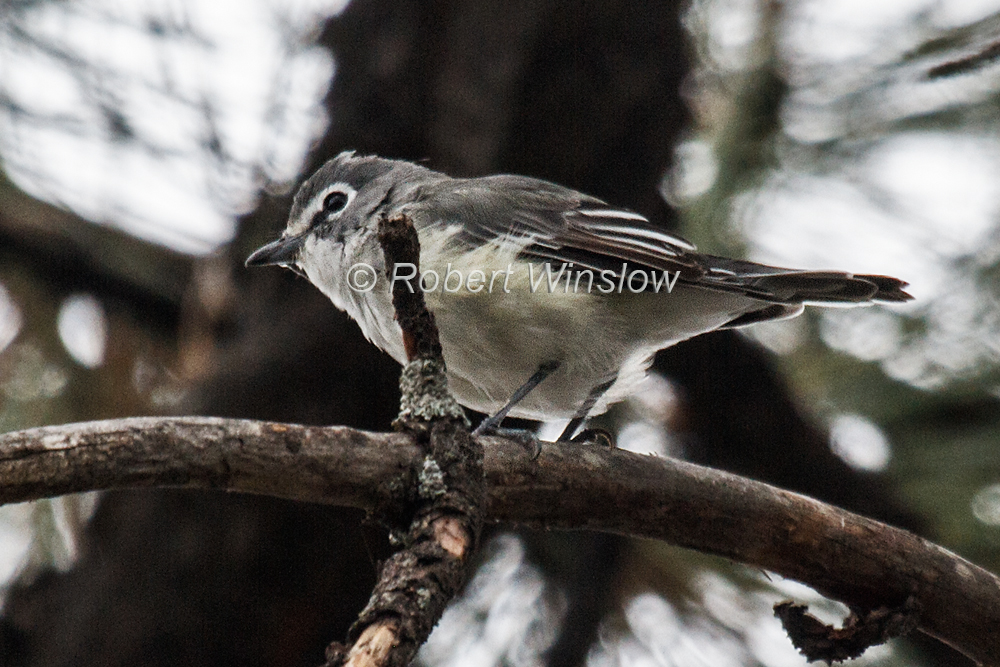
Susan was a great teacher, I learned a few new birds and with her help I was able to photograph a couple of birds I had not previously photographed: a Plumbeous Vireo and a Cordilleran Flycatcher.

Plumbeous Vireo, Vireo plumbeus, La Plata County, Colorado, USA, North AmericaPlumbeous Vireo, Vireo plumbeus, La Plata County, Colorado, USA, North America


Cordilleran Flycatcher 5149W1WMCordilleran Flycatcher 5147W1WM


Sadly – or maybe happily for the neighbors – no one has seen the bird again in the area.